
Taste
Plant Parts Used
Therapeutic Properties
Purgative, Alterative, Anti-inflammatory, Bitter Tonic, Emmenagogue, Laxative, Rejuvenative & Vulnerary
Ayurvedic Character
Cooling
Current Uses
Botanical Family: Asphodelaceae
If you’re at all slimy texture-averse, you probably avoid aloe vera already. It’s notoriously goopy stuff, with a half-set gelatin consistency that is the absolute ooziest. But if your flesh has recently been scorched in an unfortunate kitchen incident, by the careless use of fire, or by our nearest star, you know to reach for something, anything, that contains aloe.
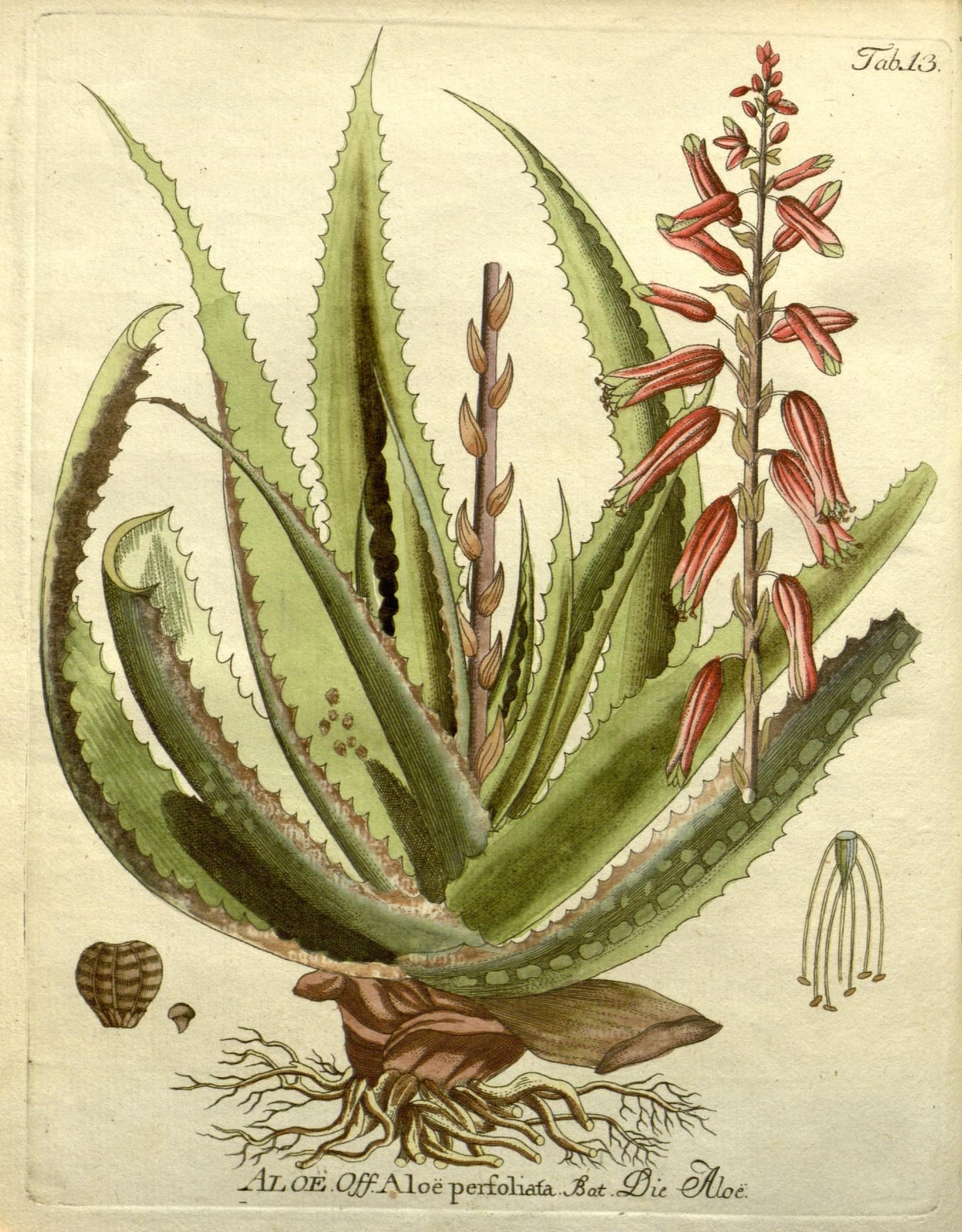
Primarily used for topical application, the gel has an instantly cooling and calming effect on inflamed, injured, or burned skin. You can break open one of its succulent leaves and spread the gel directly onto a burn, or squeeze it right out of a bottle for slathering over a sunburn (pro tip: keep the bottle of gel in the fridge for extra cooling effect). The best-known of the hundreds of aloe species, aloe vera has earned a reputation for quick, reliable relief. This famous gel has also been used for centuries in various cosmetics.
If you’ve only used aloe as a topical ointment, you may be surprised to learn that it’s also considered a delicious ingredient in beverages. The clear gel is typically diced and rinsed a few times to rid them of the sliminess. Some recipes call for boiling the pieces before using. The tiny chunks add a pleasant, crunchy texture to teas and juices. Aloe has a grassy, pleasantly bitter taste and soft, crunchy texture similar to cucumber, but you would be wise to limit consumption due to its laxative effects. You can find tiny cubes of aloe floating in various flavors of beverages in South and Central America. It pairs well with green tea, hibiscus, and cucumber, among others.
These recipes from various countries feature aloe:
Indian
Mexican
These spirits are known to contain aloe:
Plant Life Cycle
Hardiness Zone
Used in Spirits
Precautions
The yellowish-green latex contains anthraquinones, most notably barbaloin and emodin, which give Aloe its purgative and laxative effects. Aloe should always be consumed with caution and only in small, recommended quantities. It is recommended that pregnant and nursing mothers avoid consuming Aloe.
Just beneath the skin of its succulent leaves is a layer of yellow-green latex. That liquid has a green, intensely bitter taste that’s found its way into countless liqueurs. Traditionally, it’s been taken internally for constipation and inflammation—though don’t overdo it, because aloe’s laxative kick is no joke (see Precautions below). This extract was banned by the FDA in 200212.
Substitutions
While unequaled in its unique composition, some substitutions for Aloe vera include cucumber, chamomile, and calendula for cooling, soothing properties without the bitterness. Other varieties of Aloe include Aloe ferox and Aloe perryi, which are more difficult to source, but could be ideal substitutes. Like Aloe vera, precautions should be observed in particular with internal consumption.
Aloe has been a healing mainstay in Ayurveda and Traditional Chinese Medicine for centuries. And while Aloe vera is the star, other species like Aloe ferox and Aloe arborescens also find their way into medicinal and beverage traditions.
History
Origins
Aloe vera is mentioned in the Papyrus Ebers circa 1550 BC and was prized by the ancient Egyptians as the “Plant of Immortality.” Historical legend purports that Alexander the Great sent his army from Greece to obtain the plant from Socotra, an island off the coast of Yemen.
Aloe vera is the stuff of legend. Even legends themselves, like Alexander the Great, thought so. Best known for the slimy gel found in its thick leaves, its medicinal use has been prized for centuries. In his quest for relief for this troops, he secured the island of Socotra (now a part of Yemen) for the purpose of having a fresh supply of the plant to treat his wounded soldiers.11
Footnotes
- Boudreau, Mary D., and Frank A. Beland. “An Evaluation of the Biological and Toxicological Properties of Aloe barbadensis (Miller), Aloe vera.” Journal of Environmental Science and Health, Part C, vol. 24, no. 1, 2006, pp. 103–154.
- Eshun, Kojo, and Qi He. “Aloe vera: A Valuable Ingredient for the Food, Pharmaceutical and Cosmetic Industries—A Review.” Critical Reviews in Food Science and Nutrition, vol. 44, no. 2, 2004, pp. 91–96.
- Grindlay, Douglas, and Tom Reynolds. “The Aloe vera Phenomenon: A Review of the Properties and Modern Uses of the Leaf Parenchyma Gel.” Journal of Ethnopharmacology, vol. 16, no. 2–3, 1986, pp. 117–151.
- Hamman, Josias H. “Composition and Applications of Aloe vera Leaf Gel.” Molecules, vol. 13, no. 8, 2008, pp. 1599–1616.
- Langmead, Leila, et al. “Randomized, Double-Blind, Placebo-Controlled Trial of Oral Aloe vera Gel for Active Ulcerative Colitis.” Alimentary Pharmacology & Therapeutics, vol. 19, no. 7, 2004, pp. 739–747.
- Ni, Y., et al. “Isolation and Characterization of Structural Components of Aloe vera L. Leaf Pulp.” International Immunopharmacology, vol. 4, no. 14, 2004, pp. 1745–1755.
- Pothuraju, Rajesh, et al. “Hypoglycemic and Hypolipidemic Effects of Aloe vera Extract Preparations: A Review.” Phytotherapy Research, vol. 30, no. 2, 2016, pp. 200–207.
- Sánchez, Marta, et al. “Pharmacological Update Properties of Aloe vera and Its Major Active Constituents.” Molecules, vol. 25, no. 6, 2020, article 1324.
- Guo, Xiaofei, and Ning Mei. “Aloe vera: A Review of Toxicity and Adverse Clinical Effects.” Journal of Environmental Science and Health, Part C, vol. 34, no. 2, 2016, pp. 77–96.
- Manvitha, Karkala, and Bidya Bhushan. “Aloe vera: A Wonder Plant—Its History, Cultivation and Medicinal Uses.” Journal of Pharmacognosy and Phytochemistry, 2014.
- https://www.ahpa.org/herbs_in_history_aloe
- https://www.govinfo.gov/content/pkg/FR-2002-05-09/pdf/02-11510.pdf
- https://www.nccih.nih.gov/health/aloe-vera